


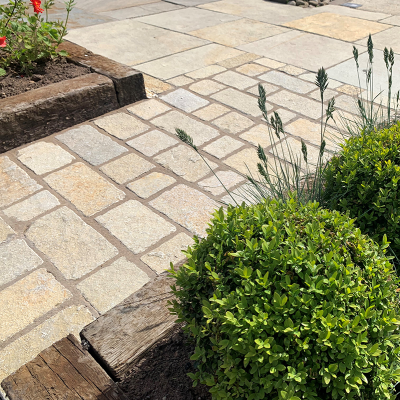
Why choose limestone paving?
The lightly riven surface gives natural grip, which makes limestone paving a practical or around hot tubs and water features. This subtle texture adds character without feeling coarse.
Many people choose limestone for its balance, since it feels refined but not formal, natural without appearing rustic.
Limestone paving colour and finish
Our limestone paving slabs are available in a wide range of tones. Popular shades include soft blue-greys, warm cream shades and versatile tan.Each limestone slab carries its own gentle variation in tone and surface detail, shaped by natural formation over time. This variation helps a limestone patio feel organic rather than uniform. The colour depth also works well alongside slate edging, sandstone paths, or smooth porcelain paving when defining different zones in a garden.
The surface remains subtle and consistent, allowing furniture, planting, and surrounding features to take focus wherever you want it to.
Limestone paving durability
Limestone garden paving performs well across changing seasons through rain, frost and hot sun. Its dense composition makes it resistant to frost damage when laid correctly, and it stands up well to foot traffic on patios and pathways, making it ideal for busy areas around your property.
When installed on a firm sub-base with suitable jointing, limestone slabs remain level and stable. This reliability makes them suitable for both domestic patios and more heavily used garden areas.
The stone’s natural texture provides grip in damp conditions without the need for an overly rough finish, so it fits with a variety of garden designs from contemporary to traditional landscaping.
How to maintain limestone paving
A limestone patio feels steady and comfortable underfoot. In summer months, it tends not to retain excessive heat, making it pleasant for outdoor dining and seating spaces where you’ll be spending a lot of time.
Routine care for limestone is straightforward. Sweeping away debris and occasionally rinsing with a quality patio cleaner will help maintain the surface in its best condition. Sealing can be an option if you want additional protection against marking (particularly in dining areas where things can spill and splash), but it’s not always essential.
Browse our limestone paving range
Explore the collection above to find limestone paving slabs suited to your project. Order samples to assess colour and texture, or speak with the Westminster Stone team for guidance on selecting the right limestone patio solution.
Frequently Asked Questions
Laying limestone paving requires a solid foundation and usually a full bed of mortar to ensure longevity and prevent cracking.
- Preparation: Excavate the area to a depth of roughly 150mm–200mm. Install a 100mm sub-base to provide a stable, well-draining foundation.
- Mortar Bed: Apply a full bed of mortar (approx. 30mm–50mm thick) rather than spots or dabs, which can cause the stone to rock or crack.
- Priming: For the best adhesion, apply a priming slurry to the underside of each limestone slab before laying. This is crucial for natural stone like limestone to prevent the slabs from lifting.
- Placement: Gently tap the slab into place using a rubber mallet, ensuring a slight slope for water runoff. Maintain consistent joint widths of 8mm–12mm.
- Jointing: Once set (usually after 24–48 hours), fill the gaps with a dedicated jointing compound or traditional mortar to secure the patio. Always ensure you follow the specific manufacturer's instructions of your selected jointing compound, as application methods and drying times can vary significantly between brands.
Regular maintenance keeps your limestone patio slabs looking pristine while preserving the stone's natural colour. Sweep regularly with a soft-bristled brush to remove leaves and debris; this prevents organic matter from breaking down and staining the porous surface.
Use warm, soapy water with a pH-neutral stone cleaner. Avoid acidic cleaners (like brick acid or vinegar) as they will chemically react with the limestone.
Westminster Stone limestone paving comes in a variety of sizes and shapes to fit a number of outdoor projects. Should you need to cut or trim limestone slabs (we recommend contacting a specialist installer), the most effective tool is an angle grinder or a stone saw with a diamond blade. Always wear appropriate PPE, including safety goggles, a high-quality dust mask (FFP3 rated), and ear protection.
Because of its durability and timeless aesthetic, limestone is one of the most versatile materials in landscaping. Its naturally slip-resistant texture makes it a favourite for garden terraces and walkways. Many limestone paving slabs, such as our National Trust Collection stay cool underfoot, making them ideal for swimming pool decks and hot tub areas.
Yes. Limestone paving slabs are a great choice for patios, commonly used in the UK because they provide a stable surface that handles foot traffic well and remains comfortable underfoot in warmer weather.
The softly riven surface of most limestone slabs provides natural grip. While no paving is completely slip-proof, limestone garden paving performs well in damp conditions when kept clear of debris, making it a solid option for walkways and patios.
Sealing is optional but often recommended. A suitable sealant can help reduce marking and make cleaning easier, particularly in high-use areas such as dining spaces or patios.
Limestone is dense and, when properly installed, resists frost damage effectively. A well-prepared base and correct drainage help protect the slabs during colder months, keeping them safe for walking on.
With correct installation and routine care, limestone paving can last many years. Its durability and natural strength make it a dependable choice for garden spaces, and explain why it’s so popular in garden designs across the UK.
