Share
20 August 2026
The Sourcing Dilemma: Reclaimed Yorkstone vs Cast Reproduction Flagstones
There is a particular kind of floor that stops people in a doorway. Worn smooth in the places where feet have crossed it for a hundred and fifty years, faintly uneven underfoot, the colour shifting from honey to grey as the light moves across the room. That is the pull of genuine Yorkstone, and if you are renovating a period home, you have almost certainly felt it. The question that follows is the classic reclaimed vs reproduction Yorkstone dilemma, and it's rarely as romantic as the stone itself: do you chase original reclaimed stone, increasingly scarce, unevenly priced, and slower to source with every passing year, or do you choose a faithful cast reproduction, made to the same patterns but manufactured to a consistent standard? Both are legitimate answers. Which one is right depends on the house, the project, and what you are actually trying to achieve. This guide is written to help you work that out, honestly, before you commit a budget to either.
What actually is reclaimed Yorkstone - and why is it so sought after?
Reclaimed Yorkstone is exactly what it sounds like: genuine sandstone flags, quarried and laid decades or centuries ago, lifted from farmhouses, mills, warehouses, and pavements, and given a second life. Its appeal is not manufactured. Every flag carries the specific, unrepeatable evidence of its age - the soft rounding of arrises worn by traffic, the shallow dishing across a threshold, lichen staining, tool marks from a mason who has been dead for a century. No cast product can claim that history because it does not have one to claim.
For certain projects, this matters enormously. If you are restoring a listed building under conservation guidance, planning officers and conservation architects will often expect, or require, like-for-like reclaimed material - though many of our reproduction tiles have also been accepted for listed use, so it's always worth checking with your listings officer before assuming reclaimed is the only route. If you already have an original stone floor in one room and need to extend it into another, reclaimed stone may be the only way to match tone, wear pattern, and depth convincingly. And for owners who simply want to know their floor once stood somewhere else, in another life, there is a value in that provenance that a reproduction, however good, cannot replicate. Where reclaimed stone is right, it is genuinely right, and no honest supplier - reproduction or otherwise, should pretend otherwise.

The sourcing realities nobody mentions
The difficulty is that "genuinely reclaimed" is a shrinking category, and the market around it does not always make that obvious upfront. Good reclaimed Yorkstone is scarce, and it is getting scarcer. Original salvage yards are drawing from a finite historic supply, demolition sources have thinned considerably, and demand from renovation projects has only grown. The result is that reclaimed York stone prices have risen sharply over the past decade, and a quote that felt reasonable eighteen months ago may bear little relation to what the same stone costs today.
Thickness is the problem that catches most people out mid-project. Reclaimed flags were never cut to a modern tolerance - depths across a single pallet can vary by several centimetres, which was rarely an issue when they were bedded into a solid, forgiving base by hand a hundred years ago, but becomes a real headache over a modern subfloor or screed. Laying a level floor from wildly inconsistent stone takes considerably more time, skill, and mortar bed depth than most quotes originally account for.
Then there is supply continuity. Reclaimed stone is typically sold as a finite batch. If your project runs over - an extension added later, a hallway that needs to match a kitchen laid two years ago. There is no guarantee the yard will have anything close to the original batch left, or that a "matching" batch from elsewhere will actually match once it is down. Lead times can also be unpredictable, since supply depends on what has been salvaged recently rather than what can be manufactured to order. And it is worth asking your supplier directly about the provenance and condition of the stone you are buying - reputable reclamation yards are generally happy to be transparent about where material has come from.
None of this makes reclaimed stone a poor choice. It makes it a choice that needs to be gone into with clear eyes, particularly on a project of any scale.
Can you use reclaimed flagstones with underfloor heating?
This is one of the most common questions we hear, and the honest answer is: with real caution, and often not easily.
Underfloor heating relies on consistent thermal contact between the pipework, the screed, and the floor above it. Reclaimed flags, with their varying and unpredictable depths, make that difficult to achieve evenly - thinner sections heat up faster and lose heat faster, thicker sections lag behind, and you can end up with a floor that warms unevenly, or a screed bed so variable in depth that it undermines the whole system's efficiency. It is not impossible, but it typically demands a highly experienced fitter, a generous bedding allowance, and a degree of stone selection and sorting that adds real time and cost to the job.
This is precisely where a cast reproduction earns its place, particularly in a modern renovation of a period home where underfloor heating is being installed for the first time. A flag that is manufactured to a consistent thickness sits evenly over the heating system from day one, with no need to compensate for a floor's worth of individual variation.
The reproduction alternative - cast from the originals
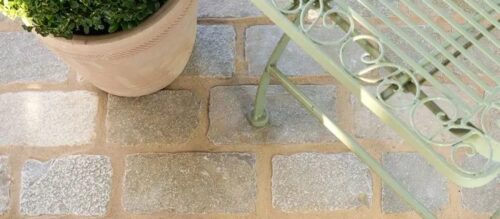
This is where Westminster Stone's own reproduction range, Stonecast, sits. Rather than starting from a blank design, we cast our flags directly from genuine, carefully selected historic Yorkstone originals - the same worn edges, the same tooling marks, the same irregular surface texture that gives reclaimed stone its character, faithfully captured in the mould.
What changes is everything about how the stone performs on site. Every flag is manufactured to a consistent, specified thickness, so it lays flat and true over a modern subfloor or an underfloor heating system without the guesswork that reclaimed stone demands. Because it is manufactured rather than salvaged, supply is reliable - if your project grows, or a room is added years later, we can produce more to the same specification, rather than hoping a reclamation yard happens to have something close. And because it is not competing in an increasingly scarce secondary market, pricing is stable and predictable from quote to completion. You can see current thickness specifications and finishes across the Yorkstone paving slabs range.
If it is specifically that reclaimed internal-flag look you are after, rather than exterior paving, our Old Cotswold Flooring range is built for exactly that brief — the same weathered, sought-after character, without the depth inconsistency or scarcity this guide has walked through.
For outdoor projects, the same cast-from-original approach carries through to our Yorkstone paving materials, and the wider Old Cotswold paving collection for a broader reclaimed-effect exterior palette.

So which should you choose?
There is no single right answer here - only the right answer for your project. As a general guide:
Choose reclaimed
You are restoring a listed building with a conservation requirement for original material
You are extending an existing genuine stone floor and need the closest possible match
Provenance and authentic age matter to you as much as appearance
Your budget and timeline can absorb price volatility and variable lead times
You have the flexibility to work with an experienced fitter around highly variable stone depths
Choose reproduction
You want the reclaimed look without the sourcing risk or lead-time uncertainty
You are installing underfloor heating and need a consistent, even thickness
Your project may grow over time and you need guaranteed future supply
You want predictable, stable pricing and a fixed lead time
You want a straightforward lay over a modern subfloor without specialist sorting
A few honest answers to the questions we are asked alongside this one: flagstone floors, whether reclaimed or reproduction yorkstone, do run cooler underfoot than carpet or timber, though this is easily addressed with underfloor heating or well-placed rugs. Durability is rarely a concern either way - genuine stone, salvaged or cast, is built to outlast most other flooring materials by generations. And the advantages that draw people to flagstone in the first place - natural texture, timeless character, and a floor that genuinely improves with age - hold true whichever route you take.
If your home is listed, or protected under a conservation area, it is always worth reading our separate guide on choosing flooring and paving for listed and period properties before making a final decision, as the regulatory picture can shape your options more than aesthetics alone. And if you are weighing natural stone against other materials entirely, our comparison of natural stone versus porcelain paving covers that broader ground.
Whichever path suits your project, the goal is the same one that has always driven Westminster Stone: a floor that looks, and feels, like it has always belonged in the house.
Still weighing up your options?
Every project is different, and the right answer often becomes obvious once you have the stone in front of you rather than on a screen. If you would like to see and feel the difference for yourself, order a free Stonecast sample. And if you are still deciding between reclaimed and reproduction yorkstone, or working through a listed-building requirement, get in touch with our team - we are always happy to talk through what will genuinely work best for your home, not just what we sell.

About the Author
Sian McHugh
'Sian has been working with us at Westminster Stone for over 7 years and has developed expertise in garden design and landscaping. Her passion for nature extends to tending her own garden, teaching yoga and hiking during her free time.'